
New 2026 EPA regulations are completely reshaping commercial HVAC procurement and maintenance. Learn how low-GWP mandates impact your facility’s bottom line.
Navigating the 2026 Low-GWP Refrigerant Transition: A Commercial Facility Guide
The operational landscape for commercial facility managers, building executives, and industrial property owners is undergoing its most sweeping regulatory overhaul in decades. Moving through 2026, the Environmental Protection Agency’s (EPA) phasedown of high Global Warming Potential (GWP) hydrofluorocarbons (HFCs) is no longer a distant compliance date on a corporate calendar—it is an active, day-to-day reality governing procurement, capital planning, and preventative maintenance strategies. For enterprises operating extensive portfolios of chillers, rooftop units (RTUs), and large-scale split systems, understanding this paradigm shift is absolutely vital to safeguarding operational continuity and controlling overhead costs.
At J&D Mechanical Services, we recognize that managing complex mechanical infrastructure requires precise technical insight and forward-thinking asset management. The 2026 mandates are fundamentally altering equipment availability, baseline manufacturing engineering, and corporate mechanical service liabilities. This comprehensive guide delivers an objective analysis of the current regulatory shifts, breaks down the technical characteristics of next-generation commercial refrigerants, and offers a practical roadmap to help you protect your bottom line.
Decoding the AIM Act Mandates for Commercial Facilities
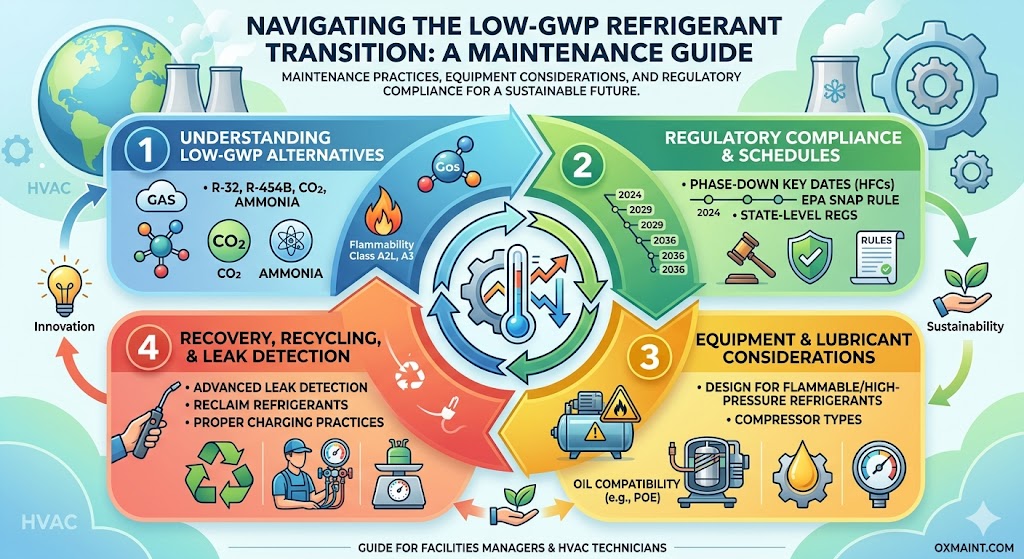
To effectively manage facility risk in 2026, building owners must look directly at the implementation milestones of the federal American Innovation and Manufacturing (AIM) Act. This sweeping legislation empowers the EPA to enforce an aggressive, phased reduction of standard HFC refrigerants, forcing an 85% reduction in production and consumption by the year 2036.
For the past twenty-five years, R-410A has served as the workhorse fluid for commercial light-duty RTUs and multi-split systems, while various other high-GWP HFC blends powered heavy-duty centrifugal and screw chillers. Under the current 2026 framework, strict maximum GWP caps have officially taken effect, effectively banning the manufacture and installation of new commercial comfort cooling systems utilizing legacy HFCs.
This structural shift requires facility teams to recalibrate their long-term capital expenditure models. Equipment manufacturers have entirely re-engineered their commercial catalogs to deploy an emerging classification of fluids known as A2L refrigerants. These modern compounds boast excellent thermodynamic characteristics, reducing direct environmental impact by up to 75% to 80% compared to legacy options, while helping enterprise entities meet aggressive corporate ESG (Environmental, Social, and Governance) targets.
Analyzing the Operational Shift: R-454B and R-32 in Chillers and RTUs
Deploying next-generation machinery utilizing R-454B, R-32, or hydrofluoroolefin (HFO) blends introduces significant changes to building operations, facility safety planning, and technician field protocols:
-
Optimized Full- and Part-Load Efficiencies: Because next-generation low-GWP refrigerants feature superior heat transfer efficiency, 2026 commercial equipment registers notable improvements in Integrated Part Load Value (IPLV). When paired with variable-speed magnetic-bearing compressors, these platforms reduce facility energy consumption.
-
Flammability Classifications and Code Compliance: A2L compounds carry a “mildly flammable” classification under ASHRAE Standard 34. While they feature an incredibly low flame speed and are highly resilient to ignition, updated commercial building codes mandate integrated leak-detection sensors, automated ventilation interlocks, and dedicated mechanical room exhaust configurations.
-
Advanced Field Servicing Protocols: Due to the technical nuances of A2L systems, commercial service teams must use specialized, non-sparking reclamation equipment, calibrated digital manifolds, and certified purging processes during installation and routine circuit adjustments.
Facility Executive Advisory: A2L flammability should not be a source of operational friction. The concentration levels required to spark ignition are extremely high and virtually impossible to reach within a code-compliant, properly engineered mechanical space or roof footprint.
Capital Planning: Asset Management vs. Accelerated Retrofits
With capital constraints weighing heavily on many corporations, procurement officers are faced with a challenging decision: do you continue repairing depreciated R-410A asset lines or accelerate capital replacements to the 2026 standards?
If your facility’s central cooling plant or rooftop assets are well within their operational life cycle (under 10 to 12 years old) and showing strong mechanical integrity, systematic preventative maintenance is your best financial path forward. Legacy fluids remain legally available for field service repairs. However, because federal production caps are shrinking the supply of older HFCs, the raw cost per pound of R-410A is projected to rise exponentially, significantly increasing the financial exposure of an unaddressed circuit leak.
Conversely, for central assets approaching 15 to 20 years of age, or facility units showing chronic compressor breakdown patterns, continuing to invest in legacy repairs is a sunk cost. Transitioning to a modern 2026 platform safeguards your operations against future chemical shortages and immediately lowers peak-demand electrical utility charges. Additionally, modernizing your facility can leverage commercial energy efficiency tax deductions, such as Section 179D, alongside substantial regional utility demand-response rebates designed to reward infrastructure electrification.
Partnering with J&D Mechanical Services for Enterprise-Grade Compliance
Navigating industrial-scale HVAC transitions requires an experienced mechanical partner that delivers verified technical execution, comprehensive safety compliance, and direct commercial transparency. J&D Mechanical Services stands ready to support your facility operations.
Our commercial service specialists hold advanced certifications across complex commercial platforms, variable refrigerant flow (VRF) technology, and the strict safety protocols governing A2L systems. We do not apply generic, standardized solutions to custom commercial facilities. Our engineers execute thorough building load calculations, pressure drop assessments, and structural integration reviews to ensure every system replacement is perfectly configured to meet your building’s specific occupancy profiles and industrial processing demands.
The mechanical sector will continue to evolve, but our commitment to protecting your commercial investments, reducing your operational liabilities, and maintaining absolute environmental control remains unwavering. Let us help you eliminate compliance guesswork and build a resilient infrastructure strategy for the future.
Ready to optimize your facility’s mechanical efficiency and mitigate regulatory risks? Contact the corporate mechanical experts at J&D Mechanical Services today at 540-349-2408 or visit us online at janddmechanical.com to schedule an industrial system evaluation and asset lifecycle consultation.